• Skip to main content

The Grief and Happiness Alliance

  • Home
  • About
    • The Grief and Happiness Alliance
    • The Grief and Happiness Alliance Gathering Reservation
    • The Grief and Happiness Alliance Nonprofit Organization
    • Donate to our Nonprofit
    • A letter of endorsement form Marci Shimoff
    • About the Founder Emily Thiroux Threatt
  • Books and Cards
    • The Grief and Happiness Handbook
    • The Grief and Happiness Cards
    • Loving and Living Your Way Through Grief
  • Blog
  • Speaking
  • Contact

Community

Going it Alone

June 2, 2021 by Emily Thiroux

In an online meeting I was attending this morning, we were introducing ourselves, and when I told them about my book, they all wanted to talk about their grief. Most of the group expressed how they hadn’t really dealt with their grief because it was hard for them to talk about. They said things like they didn’t think other people would want to hear about, or they didn’t want to bring other people down, or that they didn’t want to deal with the sadness that comes to them when they do talk about their grief.  They also pointed out that they knew people grieving over losses other than grief.

Right now, it seems like we all are dealing with some form of grief whether it is from the loss of a loved one or the loss of a job, a home, an income, a pet, or anything important to our lives. And most of us just deal with our grief on our own then wonder why we are having a hard time.

When grieving, people tend to withdraw from other people to avoid the sadness, the crushing pain, or the reactions they get when they mention it. Does this sound like you or someone you know? With my own grief, I tended to keep to myself for the first couple of months. I just didn’t want to talk to anyone. And I didn’t want to listen to anyone either. Hearing them talk about anything other than my loss was difficult to deal with.  How could they care about what to fix for dinner or a new purchase they made?

Eventually I got to a point where I did want to talk or listen, but by then I needed to connect with people again. I tried to find groups on social media that I could join and be able to communicate, but I discovered so much sadness. At first, I was replying to every devastating story I read, and in the process, I seemed to be absorbing that sadness. I would stop writing when I was in tears. I realized that doing this wasn’t helping anyone.  The people who were writing the stories just needed to tell their stories and weren’t prepared to listen to a response. I assumed that because I never received a response from anyone I wrote to.

Eventually I decided to find new friends and I created a Meet Up group and invited people to join me to write about what we were grieving.  This worked. Meeting face to face we were all able to share and respond to each other. We all realized how much we needed to share our stories.  By meeting with this new group, I became more comfortable in reaching out to my friends, and they responded. I think they always wanted to but weren’t sure what to say. My reaching out to them broke the ice and we easily fell back into the relationships we had before my loss. And, when they were ready, they talked to me about how the loss affected them, too.

If you feel stuck now, don’t despair. People still love you. New people will love you, too. When you are ready, open your heart and allow people back in.


You can order Loving and Living Your Way Through Grief  by clicking here at Amazon.

I would be happy to put you on the reminder list for or Writing Together Through Grief occurring on Saturdays each week by sending an email to me to [email protected] and giving me your email address.

Join my Facebook group here.

Filed Under: Community, Grief, Loneliness, Loss, Self-Care, Someone to talk to Tagged With: community, friends, grief, grieving, healthy coping mechanisms, how to deal with grief, self-care

Bereavement Leave

May 12, 2021 by Emily Thiroux

I am thrilled to hear that President Biden has proposed the Family Medical Leave Act which would include bereavement leave. Although this hasn’t passed yet, and we can’t know exactly what it will stipulate until it is enacted if it is, at least it is a step in the right direction.

Allowing adequate time for people to deal with the dying and death of a loved one should be a priority in our society. When each of my parents died, even though I had a good job working for the state, bereavement leave wasn’t part of my benefits.  I only could get off work using sick leave and then I wasn’t allowed more than three days.  I also was working part time at another job at the time, and they graciously allowed me to take time off that I needed to tend to all I had to deal with at the time, but that time off was unpaid.

I wonder when businesses or the government are making rules about bereavement if the people making the rules have ever suffered a loss.  I can imagine someone in the Human Resources department of a company telling and employee who had just called in to report that his son had been killed by a car in a crosswalk, that the HR person would say “I’m sorry for your loss, but this company does not provide bereavement leave. Be sure to come in to work today so that you won’t risk losing your job for not showing up.” Yes, things like this do happen.

Think about it. Recall how you felt immediately after your loved one died. Even three days later, were you capable of doing whatever your job was?  I felt like I was teaching like a robot, providing essential information but not engaging with my students.  The evaluations my students submitted about me the quarter my father died unexpectedly were the worst I ever received, even though my evaluations were usually very good.  When employers expect their workers to keep the standards they always had while they are dealing with the fresh trauma of grief is completely unreasonable.

Because I took care of both of my husbands at home for two years before their deaths, I wasn’t working at the time they died.  There was no way I could have worked either time. I was fortunate to have close friends who handled any arrangements that were essential while I sat in a fog or curled up in bed. I can’t imagine how I could have worked either week.

I wrote this blog because I want us all to think about the concept of bereavement leave so that any time it comes up, we can advocate for it. This could be anything from talking to a friend who owns a business and asking them what they do.  This could start a conversation that could lead to change.  Also, contact your lawmakers and ask them to advocate for bereavement leave whenever they can. Even talk with your friends.  You may just be planting a seed that can lead to positive changes.

And when loss comes to you, be sure to take care of yourself. Rest, eat well, meditate.  Allow yourself the time to reset your focus. And when loss come to those you care about, be sure to support them with love.  That’s always my intention to do for you.


I would be happy to put you on the reminder list for or Writing Together Through Grief occurring on Saturdays each week by sending an email to me to [email protected] and giving me your email address.

You can order Loving and Living Your Way Through Grief  by clicking here at Amazon.

Filed Under: Community, Grief, Loss, pressure, Support, Uncategorized Tagged With: grief, grieving, losing a loved one

Growing What is Good

April 29, 2021 by Emily Thiroux

I started a Produce Share with neighbors when we first moved to Maui because we had such an abundance of fruit on our property, and I didn’t want it to go to waste. Every Friday, people would stop by and bring what they had to spare from their gardens, and we would share, no money exchanged.  Sometimes we even made jam or banana bread to share. And I found a way to share all the papayas, lilikoi, bananas, and avocados I had.

When the pandemic hit, the grocery shelves became bare.  Since Hawaii is said to be the most remote place in the world, we heavily rely on barges to bring in food from the mainland and other countries.  I thought of the Victory Gardens people planted during World Wars I and II where people grew and shared what they could from their gardens to be sure their families and friends had enough food to eat.

Since our produce share is still going after five years, I decided to expand my garden to have even more to share. I hired a gardener to put in some irrigation for me so as not to waste water, a precious commodity on an island.  He turned out to be an expert in in permaculture gardening, so I asked him to put in a huge garden to provide lots more food to share.  He used lemon grass and comfrey to make a beautiful border and keep the grass from the lawn from growing into the garden.

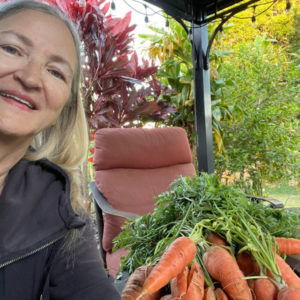
My new garden has gotten so big that I now have a lovely young woman who helps me keep it up with weeding and planting.  Yesterday she surprised me with a giant bunch of carrots she had pulled. I was surprised because I didn’t know they were there! Last spring before my big new garden was planted, I bought a package of carrot seeds and planted them, watered them, weeded around them, pulled them from the ground, shared them, and ate them.  I didn’t realize that I had left some of them in the ground.

Then one day I noticed one day that I was growing pretty white flowers in my vegetable garden.  At the top of tall green stems sat balls of little white flowers clustered together in the shape of pom-poms.  Upon investigation, I discovered a few giant carrots shouldering up from the ground attached to these flowers.  I had never seen carrot flowers before. My gardener told me to cut them, put them in a paper bag, and let them dry out.  When they were dry, I shook the stems, and a lot of tiny black seeds popped out, so I planted them.

I planted those carrot seeds next to the lemon grass, not understanding how large it would become.  When the distinctive carrot tops grew, they were hidden in the tall lemon grass, so when my garden helper discovered them yesterday, we were delighted! Precious food from the garden tastes the best!

My carrots seemed a metaphor for the cycle of life. We are born from tiny seeds which are nurtured as they grow. They provide food, beauty, and more tiny seeds to start the cycle again. We all grow through our own cycles, and on our way, the more we grow and share, the happier we are. Ultimately, our sharing is complete, and we have the opportunity to revert back to the soil and create more new food and beauty.

I am grateful I have so much beauty and bounty to share which makes my life just that much richer. What bounty do you share?


I would be happy to put you on the reminder list for or Writing Together Through Grief occurring on Saturdays each week by sending an email to me to [email protected] and giving me your email address.

You can order Loving and Living Your Way Through Grief  by clicking here at Amazon.

Filed Under: Community, Creativity, Food, Gratitude, Health, Healthy Eating, Support Tagged With: community, friends, Gratitude, grief, healthy coping mechanisms, Pandemic, self-care

Will it Ever End?

March 24, 2021 by Emily Thiroux

I saw on the news last night about another mass shooting. They showed a picture of each of the ten victims and shared who they were. I found myself teary, which led to actually crying. I didn’t know any of these people and I’ve only been to Colorado once, so I asked myself why this affected me this way?   And I realized that I was dealing with compounding grief.

This shooting brought back memories of way too many more mass shootings. I even knew a victim of once of these incidents.  Fortunately, she didn’t die, but her being hurt reminded me that this could happen to anyone anytime.  They not only happen in in clubs, in theatres, and at concerts, but also at school and even church.  A mass school shooting happened in the 70’s in San Diego at a school close to where we lived.  My children were walking to school with a helicopter flying low over them, and when they got in their classrooms, the doors were locked. Another shooting happened when they were in junior high school and a shooter was shooting into classrooms from a park across the street. Fortunately, in that instance, no one was hurt.

As I considered my reaction last night, I recognized that I don’t fear mass shootings.  There is no way we can know when something like this will happen, and fear wouldn’t change or help anything. What does happen with me is memories of my loved ones who have died.  I am reminded of all I will never experience again with all these people.  No more conversations, no more hugs, no more celebrations. My heart aches for those who loved these current victims thinking about all they will miss now. This I am sure is what brought the tears.

Tragedies like these happen as a part of life. If guns weren’t available, people who want to create this mayhem will find another way. Dwelling on these heart wrenching events does not serve us. Instead, we can use devastating events like this as an inspiration to live our best lives now when we can. Focus on each moment, sharing love and giving support to people we love every chance we get. Recognize all the love and beauty you have in your life right now and do whatever you can to multiply that. Don’t leave things unsaid that can lead to regret later. And include yourself in all that love. You are precious and special and deserve great experiences. Make them happen.

And instead of focusing on the sorrow you hold about the people you have lost, focus on the love you shared. Remember all the good things and know they will always be in your heart. When things happen that appear to be negative, always search for the bright side and actively do something that will make you and the loved ones you are surrounded by now feel all that love you are sending out. And remember to graciously receive that love they are reflecting to you.


I would be happy to put you on the reminder list for or Writing Together Through Grief occurring on Saturdays each week by sending an email to me to [email protected] and giving me your email address.

You can order Loving and Living Your Way Through Grief  by clicking here at Amazon.

Filed Under: Community, Love, Support, Uncategorized Tagged With: community, friends, grief, healthy coping mechanisms, how to deal with grief, love, memories, self-care, support

Serendipity

March 10, 2021 by Emily Thiroux

I am featured on a podcast created by Paul Samuel Dolman called What Matters Most. I became acquainted with Paul by an amazing journey of coincidences.  Two years ago, I traveled from Maui to Los Angeles to do a presentation at Soul Sisters Retreat, one of my very favorite places to go.  When I got to LAX, a giant-sized airport, I waited what seemed forever for my bus to arrive to take me to my rental car.  I had booked through a small rental company, and I became concerned that maybe they didn’t have a bus as the large busses from the large companies whizzed by. Finally, a small bus drove up and when I boarded, there were only two others in the bus. I couldn’t help but hear their conversation, and one voice sounded very familiar.

I heard Kate’s unmistakable Tennessee accent, and sure enough, it was Kate! Kate and I had been business partners years before she moved back to Tennessee.  She was surprised to see me, too! She introduced me to her friend Leisa as an author from Maui. Leisa said she had a friend who was an author from Maui also, Paul Dolman.  And Kate explained to me that the only reason they were on that bus was that their flight from Tennessee had been delayed for 8 hours making our chance meeting possible.

When I got to my room, I decided to look Paul up on Facebook to see who he was.  We had one mutual friend, and that friend was my agent Meriflor, in Toronto!  I emailed Meriflor and she said that Paul is a wonderful person and that when my book came out, she would contact him to do an interview with me. Unpacking, I picked up the book I was reading, Hitchhiking with Larry David, and the author was Paul Dolman, who also wrote the last book I read, Seven Crazy Days on Maui.  In that book he mentioned people and places I knew on Maui.

My book, Loving and Living Your Way Through Grief, was published in January, and as promised, Meriflor contacted Paul to interview.  Paul let me know that he was pretty booked up so that it would probably be a while before he could get me on his podcast, and he asked me to send him a copy of my book.  A week later he emailed me and asked if we could talk right then, so we Skyped. He had read the book just as the country was reeling from over 500.000 deaths from the pandemic. Paul said that the information in the book was so valuable that he wanted to get the word out about it immediately, so we recorded the podcast right then!

That podcast was released today on What Matters Most.  You can listen to it by clicking here.

I would love to hear what you think about it.


Filed Under: Community, Gratitude, Joy, Support, Writing Tagged With: bereavement gifts, grieving cycle, healthy coping mechanisms, how to deal with grief, practicing gratitude

The Stories We Tell

January 28, 2021 by Emily Thiroux

We all tell stories, but are we telling the truth in those stories? When we tell the story of the loss of our loved one, we may only tell part of the story leaving out what we think the person we are telling the story too wouldn’t be able to handle. Or we may share way more than the person we are talking to can handle. Think about stories you tell, and then think about why you are telling them.

Your stories can bring you the support you desire.  For instance, you may tell a story of your desire to spend more time with your friends. In that story, you may say only one or two friends are staying in touch with you. You can bemoan the fact no one else calls you or that you spend so much time alone. Think about how the person you are telling your story to will react to the story you are telling.  They could think “She sounds so sad.  I can’t handle being around that sadness now because I am barely hanging on.” Or they could think “I understand that loneliness, and I will do better at staying in touch.”  How you tell your story will affect what the results you will get will turn out.

When you change your story to something positive, you are more likely to get positive results.  For instance, when you tell your story about how you want to spend more time with your friends, try changing up your story to say something like “I loved before the pandemic how we used to get together to visit over a cup of coffee at our favorite café every Monday at 10 AM. I was thinking, we could still do that now.  Instead of the café, let’s facetime or Zoom at the same time, or even talk on the phone.”  If you heard that story from your friend, wouldn’t you say “Sure.  I would love to do that.  I do miss our time together. This would be a great way to catch up.”

Or you may tell the same story to every new person you come in contact to.  For instance, I could introduce myself as a widow who has had two husbands die. If you met me and I said that to you, what would your reaction be?  Chances are you may be kind yet have no desire to spend more time with someone dealing with so much loss. In this time of a pandemic, you have enough to deal with already.  But if I introduced myself as a person grateful to meet someone new, you would probably be more interested in getting to know me better.

What is your story now?  Are you telling the truth about who you are? Are you a person who loves real conversations? Do you hold back information that could help you share what you really want to? Or maybe you say way more than you meant to? Spend some time thinking now about how you would like others to perceive who you are. What stories can you tell to develop the relationships you would like to have?  What stories to you need to keep for yourself? Telling the stories that support the outcome you desire can go a long way to bring more joy into your life.

Try writing your stories in your journal. Often, writing out a painful story in detail can help you discover the truth in it while releasing the need for it to keep circulating in your mind making you sad or holding you back.  Years after I had a terrible experience, it kept surfacing in my thoughts. After I took the time to actually write it out with all the freighting details, I realized that I was able to let the story go. Nobody else saw what I wrote, and I was able to tear it up and throw it away.  I was amazed that after I got the story down on paper, I released all the feeling that went along with it.

Think about stories you tell, and then think about why you are telling them. How do your stories serve you? Sometimes the stories you tell can drive someone away. Your stories can also bring people closer. Telling your stories can bring you joy when you allow them to. Before you tell your story, ask yourself these questions. Does this story need to be told? And if it does, how can I tell it with love in a way it can bring joy?

Bring love and joy to others, and to you, with the stories you tell.


You can order Loving and Living Your Way Through Grief  by clicking here at Amazon.

I would be happy to put you on the reminder list for or Writing Together Through Grief occurring on Saturdays each week by sending an email to me to [email protected] and giving me your email address.

Filed Under: Community, journaling, Joy, Someone to talk to, Support, Writing Tagged With: bereavement gifts, grieving cycle, healthy coping mechanisms, how to deal with grief, losing a loved one, practicing gratitude

  • « Go to Previous Page
  • Page 1
  • Interim pages omitted …
  • Page 12
  • Page 13
  • Page 14
  • Page 15
  • Page 16
  • Interim pages omitted …
  • Page 19
  • Go to Next Page »

Read Emily's Grief and Happiness Blog

Read the Blog

Listen to the Grief and Happiness Podcast hosted by Emily Thiroux Threatt

Listen Now

Newsletter Signup

Sign up

Grief and Happiness Sunday Gathering Reservations

Sign up

© 2026 Emily Thiroux Threatt · All Rights Reserved · By PixelPerfect · Privacy Policy

Instagram LinkedIn Facebook

Sign up for our weekly newsletter by clicking here