• Skip to main content

The Grief and Happiness Alliance

  • Home
  • About
    • The Grief and Happiness Alliance
    • The Grief and Happiness Alliance Gathering Reservation
    • The Grief and Happiness Alliance Nonprofit Organization
    • Donate to our Nonprofit
    • A letter of endorsement form Marci Shimoff
    • About the Founder Emily Thiroux Threatt
  • Books and Cards
    • The Grief and Happiness Handbook
    • The Grief and Happiness Cards
    • Loving and Living Your Way Through Grief
  • Blog
  • Speaking
  • Contact

Support

Pain is Essential to Healing

September 2, 2020 by Emily Thiroux

I just finished reading Ibram X. Kendi’s book: How to be and Antiracist, such a powerful book helping me to put into perspective what is happening in our country today. The book is filled with humanness and things to think about. And he puts in the perspective of the fragility of life.

Kendi’s wife and Kendi himself both experienced cancer in the early times of their marriage. His was Stage 4 colon cancer. After losing Chadwick Boseman to colon cancer last week, I immediately thought, Oh no! We can’t lose another brilliant mind right now while we are in the middle of this, especially since his writing is helping us to understand and learn what we need to so that we can deal with the issue of racism. I was relieved to read that Kendi was in that very small minority of people who survived Stage 4 colon cancer.

In relating his story in the book, I was struck by his sentence: “Pain is essential to healing.” Those of us who have suffered loss go through the process of learning this lesson. We have felt the depth of despair that follows loss. And for many of us, dragging ourselves up from those depths can be seemingly impossible. Yet ultimately, we find our way to the new people we become. The deeper our pain, the more profound our change becomes.

The way I dealt with that upward journey was to focus on learning what I was to do next. Last week I wrote in my blog about discovering my purpose and how that became my focus in healing. Ironically, just after I published my blog, I saw a clip of the speech that Chadwick Boseman made to the graduating class at his alma mater, Howard University. His message was for the graduates to focus on their purpose. Watching that made me feel like he was giving me a reminder that I am on the right track.

Feeling that our lives have no purpose when we are dealing with loss is a common reaction. Recognizing that this is happening is the first step to dealing with it. When you feel that deep pain, take some time to explore it. What hurts? How does it hurt? Are you clinging to that pain? Are you ready to release it? Try making friends with your pain. Acknowledge your pain, respect it, and ask it what it wants from your experience with it. I encourage you to journal about this and see what you discover.

I found that my pain was all encompassing, affecting every aspect of my life. And I discovered that it had served its purpose ,and that I didn’t need it to hold me down like an anchor, forever impeding me from moving forward.  When I recognized this, I thanked the pain for the part it played in the process of my grief, and I released it with love. This process brought a tremendous relief. Although I knew I wasn’t finished with grief, I also knew that I no longer would be held down by it. I could now look at my life and find what I wanted to do next.

I encourage up to deal with your pain and discover its lessons.


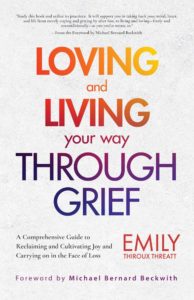
Click here if you would like a preview of my new book, Loving and Living Your Way Through Grief.

Filed Under: Grief, journaling, Support

Purpose

August 27, 2020 by Emily Thiroux

In grief, our roles shift from those we had before our loss to those we have after. Often our before roles are clear and we tend to do them without having to think much about them. After, though, we often aren’t sure what to do.  Before your roles may have been things like caretaker, lover, and companion. After those roles may need to be replaced with something else.

For me, with both Jacques and Ron, I had spent two years each focusing on their needs, both physically and emotionally.  My life was consumed with all things related to them.  After Jacques I was lost and took a long to time start to figure things out. But after Ron, I discovered that the one thing I focused on most was now what was I supposed to do. What was my purpose?

I journaled and explored what I loved to do, what I desired to do, what was next for me.  Though the answers didn’t come quickly, they prepared me to be ready to say yes when I realized what my new purpose was. When the realization dawned on me that what I would love to do is to help others who have also experienced loss by using the skill I am most comfortable with: writing. And this realization came to me when I noticed that was what I had already started to do.

I love creating relationships with others who can use what I have to give. My new relationships are deep and lovely, and I am grateful for them. The process naturally evolved for me without my noticing till one day I realized that what I had done so far was the perfect content for a book. So I wrote it, it is being published, and I will be able to touch so many more people.

What is your purpose? There is so much to do in our world right now.  Our country is suffering from fires, hurricanes, lack of integrity, racism, violence, and a pandemic. Just looking at that sentence is overwhelming. Yet, all things can improve. And that improvement will come from individuals stepping up.  You may be thinking that all those things are so big that you wouldn’t be able to tackle them as your purpose, but this is a place you could start. They key here, is to focus on one thing and take the first step.

After my journaling, my first step was to write a letter to a dear friend whose husband died suddenly. Writing that letter allowed me to realize that I could help others by using my writing, and this process opened the flood gates for me.  What are you concerned about now, and how can you help? For instance, if you are concerned by the lack of integrity we are experiencing right now in our government, what you can do right now is be totally integral yourself. This is a commitment I have made to me, and by making that commitment, I have learned to stop myself when what I am thinking or saying may not be the absolute truth. Integrity can spread as we all focus on that.

For racism, I have started a serious self-study program to learn what I missed in my education and discover how what I say and what my actions are affect others. I never thought of myself as racist, but through my studies I have found that isn’t enough. I have committed to be anti-racist and to talk to others about the significance of this.

My purpose related to the pandemic is to learn what I need to there, and to do what I need to so that I can protect myself, my loved ones, and society in general. If we all do this, we will get through this challenge sooner and with less loss. I also use my main purpose of helping others to deal with loss by helping people dealing with loss caused by the pandemic.

I encourage you now to write out what your purpose is in life right now.  There is no judgement here. Write about your deepest desire for your life’s fulfillment.  I asked the members of my Writing Through Grief with Emily private Facebook group to do this, and Joanna Thompson Gabriel wrote from her heart and has allowed me to share this here:

“A year ago, I published a book, Re-Wired: A Sankofa Healing Journey which chronicles my healing journey through retirement which I like to call re-wirement. For me “retirement” speaks to endings and “re-wirement” speaks to beginnings. Although it has not been revealed what the results of all these tests will conclude, obviously, I am being rewired once again. I am saying hello to life.

And truly there is no way that any one of us knows all that is before us.

So the only purpose I have right now is to:

*Seek to find joy in all I do

*Live one moment at a time

*Contribute to the world with love

*Cherish all my wonderful relationships

*Continue facilitating support groups on liberation from the effects of racism, classism, and sexism.

*Share inspirational messages through word and song

*Continue in my Writing Through Grief Support Group with you Emily

*Finish the book that I am writing: My Soul Is A Witness: The Legacy of Grief.

*And, plan to live a long and fruitful life.”


I would love to read what you discover as you write about your purpose. Life is good!

Filed Under: journaling, Support, Writing

Use It Or–

August 19, 2020 by Emily Thiroux

Yesterday I drove down past the airport (wonderful to get out of the house for a moment even though I was just in my car), and I noticed there were cars parked everywhere. The cars were parked bumper to bumper and side to side and were covered with dust.  I imagine they had been there quite a while, probably since March when everything shut down. I am amazed at how many rental cars there are on Maui! And with no tourists on the island, the cares just sit there. The cars in this picture are in the dirt next to the Costco parking lot.

Ron had a Saturn Outlook that he just loved. It’s a really big car, so I don’t really like to drive it. I tried to drive it every once in a while, or loan it to a friend, but I didn’t do it often enough and I had to replace the battery, twice. I have finally come to terms that I don’t have to keep it just because it was Ron’s, so I am selling it to a friend. When I saw these cars yesterday, I wondered if any of them are going to start when the time comes that tourists can come back to the island of Maui.

I’ve always heard that if you don’t use something, you lose it.  That certainly happened to me when I didn’t drive Ron’s car. And I notice that it’s harder to get up and moving if I have only been sitting for a long while. Our bodies are meant to be used, as are our minds. When grieving, lots of times it is easier to sit, to stay home, to veg out on television, and a certain amount of this is fine. But in grieving, it is easy to get used to sitting in the same chair, binge watching a television show that doesn’t mean anything to us and allow our precious time to slip through our fingers.

Where are you in life right now? What do you want to do or accomplish this week, this year, this lifetime? Take some time to explore this. I know with both Ron and Jacques, though I knew they were ill, it seemed like they would always be there; then they weren’t. What recognizing this taught me is to leave nothing unsaid, unexperienced, or undone that I aimed to do before I couldn’t anymore. Because of this, I now do whatever I desire. My friends and I often say, “I love you.” I know none of them will wonder about my feelings for them when I am not here to tell them.  If I want Ben and Jerry’s Chunkie Monkey, I savor every bite.  If I want to take a class or write a book, I do just that.

I live each moment as if it were my only moment with no regrets.  I encourage you to do that, too. If you don’t do it, you may not get to.  Live full out with positivity, love, and joy!

Filed Under: Grief, Joy, Love, Support

Can grief break your heart?

August 13, 2020 by Emily Thiroux

Grief actually does have physical effects on your body which can be severe. Have you had your heart race through the night leaving you exhausted when you wake in the morning? Has your whole body ached? Do you barely have enough energy to get around? Have you had unexplained headaches? Has eating become a challenge, or does just the thought of eating make you nauseas? Is your blood pressure high? All of these symptoms are common especially in early grief.

Studies have shown physical reactions your body can have to grief, each of them causing lots of symptoms. Inflammation is your body’s attempt to dealing with things that harm it. When your body gets inflamed during grief, it can worsen health issues you are already dealing with or it can cause new ones.  This inflammation can affect your immune system which can lead to infections. You may develop high blood pressure or a racing pulse. All of these issues require medical attention. They may lead to PTSD, which my doctor told me I was dealing with. Or they may lead to something called Broken Heart Syndrome where intense stress leads to your heart becoming physically weak.

The message here is to take care of yourself. Here are a few things you can do.

  • Eat wisely. I know eating may be the last thing on your mind, but your body needs the strength and energy food provides. For me, I had a really hard time eating at all and lost much weight after each husband died. This led to low energy. I have also known many widows who gained lots of weight, using food as a comfort. This also doesn’t you’re your energy level and can lead to many other physical problems. The key here is good choices both in what you eat and the amount of what you eat.
  • Move your body. Exercise is likely to be the last thing on your mind, but just sitting can be deadly. Do something you really like. Walking, swimming, dancing, and running are all good. As is yoga, Tai Chi, and Qigong. There are lots of good videos online that you can watch and move along with.
  • Sleep can be tricky in grief. Often you either want to not stop sleeping or get out of bed, or you can’t seem to fall asleep no matter what you do. Figure out what works best for you and aim for 8 hours of sleep for every 24. I couldn’t sleep for a long while after Jacques died and finally got a prescription from my doctor. I ended up taking it way too long, not realizing that was a problem. Stopping taking it was hard at that point, but I did. Please be careful if you do try taking something. And be sure to be clear with your doctor how long you should take it.
  • Talk to someone. And talk about whatever you want to whether it be the story of your loved one’s transition or the flowers in your garden. Talking can be hard, but it can help so much to get things out instead of bottling them up inside. If you don’t feel like talking to a person, write. Write and email, text, or letter. Or write in your journal. Expressing what you are feeling helps take the pressure off. And don’t hesitate to go to a counselor if you feel you want to. Or you can join a grief group like the private ones I offer online where you can meet new friends virtually.

Amy Davis offers this great advice: “Lean into it. You only get to grieve your loved one once. Don’t spend the whole time trying to distract yourself or push it down. It does go away eventually, and you will miss feeling that connected to that person again. And if you feel like your whole life has fallen apart, that’s fine! It totally has. Now you get to decide how to put yourself back together. Be creative. There’s new life to be lived all around you.”

As I always say, live in the moment. Focus only on what you are dealing with in any moment. And be sure to love yourself in the process.

Filed Under: Grief, Health, Healthy Eating, journaling, Loneliness, pressure, Support, Writing

Someone Else’s Loss

August 5, 2020 by Emily Thiroux

Saying the right things to someone who is grieving can be a challenge. In the awkwardness following a death, sometimes people just don’t know what to say, so many times they don’t say anything, and I guarantee, that is not helpful. The most likely thing someone will say is “I’m sorry for your loss.” I remember years ago when the phase “Have a nice day” got popular all of the sudden. When you parted company with anyone, they were likely to say, “Have a nice day.” I first I thought that was a pleasant thing for people to do, until it became a constant drone that lost its meaning. That’s where “I am sorry for your loss” is now. People seem to think that any time they hear someone has died, those words must be spoken out of courtesy before anything else is said. I would really love if no one ever said “I’m sorry for your loss” again. Just saying these words doesn’t help anything except maybe for the person saying them that feels their obligation is now out of the way.

I heard a veteran say that she felt the same way about “Thank you for your service.” She said, “If that person was so grateful, they could give me a job, and then I’d feel the gratitude.” I have heard that for military personnel and veterans, they better thing to say is “Never forget.” I like that. If someone said something like, “I’ll never forget Ron and what a special person he was,” I would appreciate that thought. And don’t let your discomfort get in the way of showing up for your friend who needs you. With society’s attitude toward death, it’s easy to run the other way when it occurs, but that doesn’t help your friend who is experiencing the worst time of his or her life right now, and it doesn’t help you. Step up, be brave, and do what you can for your friend. And you may not need to say anything. Just listen and bring chocolate.

Here is a list of things that will be good for you to express to your friend:

Acknowledge the pain. Sometimes the griever will think they are the only one who has ever hurt like this. Tell them that their pain is real, that we all experience it at times of our lives, and let them know that you would be happy to listen.

Tell them that you don’t know what to say, and that you care, and you love them.

Tell them the favorite thing you remember about the person who died: their smile, their laugh, and events that you shared. Tell them anything positive you remember.

Let them know you will listen, then listen without judgement or advice. Sometimes we need to just express what we are feeling and know someone hears us.

Tell them if you would be happy to come stay with them for a few days or longer.

Ask them to talk to you about their loved one any time they want.

Tell them that they don’t have to talk, that you will just sit by them and be there for them.

Tell them you are so sorry that they have to go through this.

Let them know that they are in your prayers.

There are lots more things you can say. Just express yourself from the heart. Trust that you will know what to say. Be honest, be kind, be loving, and the best words will come to you. Keep in mind that when you are expressing yourself or offering advice that what you say needs to be about the person you are talking to.

What else can you do to help? My best answer is: something. The thing I heard more than anything else was “Just let me know if you need anything.” Please stop saying this now. They aren’t going to call you, of if they do, it’s likely to be at a point where they really need you right then and you may not be available. Instead, be proactive. Take them food, flowers, or little gifts weeks or months after the death. Let them know they are remembered. If you are taking food to someone who lives alone, a giant casserole is not a good idea, but that casserole divided into individual servings and wrapped for the freezer would be much appreciated.

Sometimes we let our fear hinder us from doing what we would like to or what we think is best. This is not the time to let fear get in your way. Go to your friend and offer to listen, offer to help, offer to just be there. The most important thing is to stay in touch. Share your love and support, and make the most of this very special time.


Sign up for my very special coaching to help you reclaim your joy! With this coaching, you will go from loss and grief dominating your life to discovering how you can live with love and joy by creating your new life plan. Click here.


Filed Under: Community, Someone to talk to, Support Tagged With: Helping a friend deal with loss, loss

Acknowledge Your Feelings

July 29, 2020 by Emily Thiroux

When dealing with loss, we are bombarded by feelings. Some of those feelings, like remembering love and moments of joy, can bring comfort, while others can drag us down to the depths of despair. When those feeling hit, you may fall into the abyss of suffering, unable to rise up from the mire. You have a choice of how to deal with these feelings.  You can fall into that deep hole and suffer, but you know that suffering doesn’t serve you, or you can recognize what is happening and deal with it constructively.

I found that when times like this hit, that the best thing for me to do was get out my journal and write. One way writing helped was to write a letter, which could be to my loved one, to God, to someone who brought up the feeling to me, and tell whoever I write to what I am experiencing right then and how I felt about it. One thing I dealt with was my anger at how Ron’s nephrologists handled his care. I felt that what they had done caused him great physical suffering and ultimately his death. This was a big burden to carry around.

I started dealing with this by writing to Ron, asking what he would want me to do. After more than one long letter to him exploring my feeling about this, I realised I was ready to write the nephrologists, and I did.  And I wrote the place where the dialysis was administered, and the company who manufactured the dialysis solutions, and the hospital. I was able to tell them objectively what we had experienced and the changes I saw that they needed to make. I heard back from all of them, and though I don’t know if they actually made any changes, I was able to release the anger because I felt I had done all I could under the circumstances. Think about who you could write that could make a difference in how you are feeling.

Another way to write to help you deal with your feelings is to first identify the feelings you are dealing with. Make a list which might include things like anger, loneliness, loss, guilt, and depression. Include any feelings that you are dealing with right now. Next, identify the feeling that is bothering you’re the most right now. Then, have a conversation with that feeling as if it is a person. Tell that person exactly how you are feeling including all the details. Then ask either what that feeling thinks you can do about it, or tell it what you plan to do to deal with it. Be sure to allow that feeling to respond to you through your writing. Don’t think about your writing. Just let it flow. You will be amazed at what shows up on paper.

Using these writing techniques, you can discover what your heart already knows, and you can see what you need to do to heal. This kind of writing allows you to take the very best care of yourself so that you can focus more clearly on the present moment and discover the beauty, peace, joy, and love that is always there.


Join my Facebook group to follow the progress toward the publishing of my book Loving and Living Your Way Through Grief by Mango Press.

Filed Under: Grief, journaling, Support Tagged With: Feelings

  • « Go to Previous Page
  • Page 1
  • Interim pages omitted …
  • Page 35
  • Page 36
  • Page 37
  • Page 38
  • Page 39
  • Interim pages omitted …
  • Page 46
  • Go to Next Page »

Read Emily's Grief and Happiness Blog

Read the Blog

Listen to the Grief and Happiness Podcast hosted by Emily Thiroux Threatt

Listen Now

Newsletter Signup

Sign up

Grief and Happiness Sunday Gathering Reservations

Sign up

© 2026 Emily Thiroux Threatt · All Rights Reserved · By PixelPerfect · Privacy Policy

Instagram LinkedIn Facebook

Sign up for our weekly newsletter by clicking here